
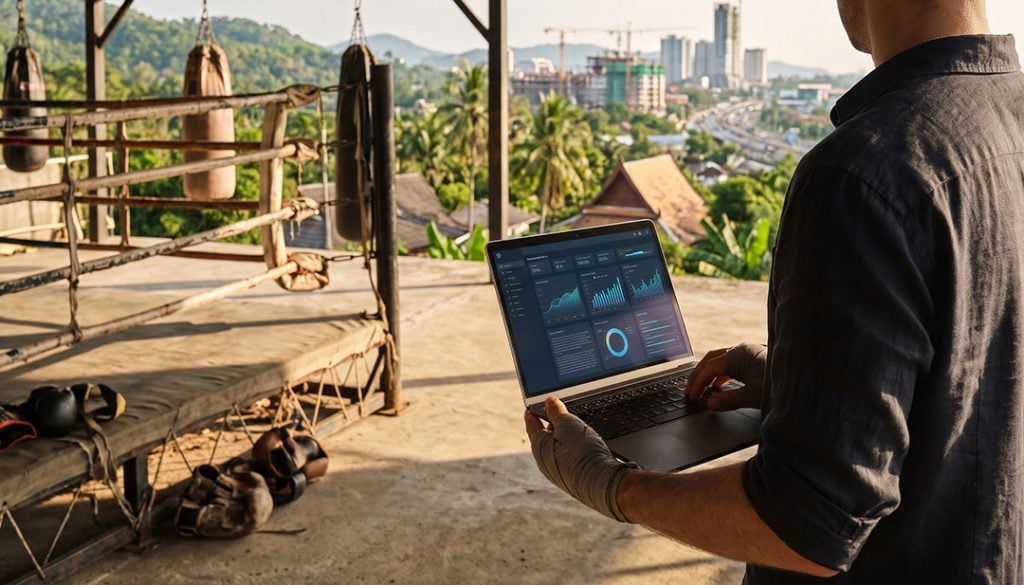
Anyone who has stepped into a Muay Thai ring – or, in my case, shuffled into one regularly at Big Gecko, Kathu to be humbled and developed by Kru Sang, my knees crackling louder than the crowd – will know that a fight is won over rounds, not in the first ten seconds. The early rounds are supposed to be for reading your opponent and finding your range; the later rounds are where fitness, discipline and the work put in months before decide who is still standing. Personally, I am only prepared to test this theory in training and not in a pro fight, given how short my stint has been so far. Throw everything in round one and you will be gasping on the ropes by round three, watching a younger, better-prepared fighter collect the points.
Business in Phuket is not so different. The bell has rung – and right now there are two fights on the card at the same time.
The first is made of concrete, steel and very large sums of money. The second is invisible, sitting quietly inside our phones and laptops, and it goes by the name of artificial intelligence.
Mega projects come to Thalang
In early October, Siam Piwat – the group behind Siam Paragon and a partner in ICONSIAM – announced ICONPHUKET, a THB 10 billion ‘Hybrid Retail-Attraction and Entertainment Destination’ due to open in 2029. It is the group’s first project outside Bangkok. The plans include 12 attractions (none yet named), more than 40% green and open space, and a showcase for the food, products and culture of all 14 southern provinces. Siam Piwat expects 80,000 to 100,000 visitors a day once it is fully up and running, and 50,000 to 80,000 jobs from construction through to operation.
Anyone familiar with ICONSIAM will know that Siam Piwat doesn’t do small – and ICONPHUKET is only the centrepiece of something much bigger. Synthesis Ark Phuket is a THB 50 billion mixed-use ‘smart city’ being developed by the Vanich family’s CV Group on around 491 rai of former tin-mining and palm plantation land on Thepkrasattri Road in Si Sunthon, between the airport and Phuket Town. Homes, offices, hotels, schools, wellness facilities and retail are all in the masterplan. The first office and commercial precinct, ‘Nexus’, is already rising out of the ground, and the first phase of the whole project is scheduled for completion by 2032. If this is done correctly, there will be a scramble for centrists to live and work there.
Whilst some will groan at the prospect of yet more traffic on Thepkrasattri Road (and I will probably be one of them, stuck behind a cement mixer at Heroines’ Monument), the bigger picture is that serious Thai capital is betting heavily on Phuket being a place where people live, work and stay all year round – not just a beach to visit for two weeks of sunburn and souvenir elephant trousers. Add the long-promised public infrastructure – tunnels, expressways and transit links that seem to move at the speed of a Patong Hill traffic jam – and the island’s centre of gravity is shifting.
Bought a tool, not changed the way we work
The second fight is harder to see. In July, the Financial Times reported on new figures from the UK’s Office for National Statistics (see “UK businesses are not deepening their use of AI, suggests ONS data” – Financial Times Online, 20 July 2026: https://tinyurl.com/5yvemaxy). The share of British businesses with ten or more staff using AI had roughly tripled since late 2023, to around 35%. The catch: the average adopter was still using only one or two AI tools, and only around one in ten described their use as ‘extensive’. The ONS itself pointed to ‘limited transformative impacts’ for most firms. In plain words – most businesses have bought a tool, but haven’t changed the way they work.
I would wager a good padel racket that Phuket is not ahead of the UK on this, but there are exceptions: I have met some very interesting business people who appear way ahead of the curve and therefore seem ‘out of place’. However, walk into many businesses on the island and you will still find a reservation taken by LINE message, copied into a notebook, typed into a spreadsheet and then lost forever when someone’s phone is dropped into the swimming pool by a careless teenager. Quotes are chased three times. Customers ask the same five questions in four languages and wait a day for the answer. None of this is a crime, but in a market about to welcome tens of thousands of extra daily visitors – and the big operators who will serve them with slick systems – it is a slow puncture in the tyre from the nails left on the road by the construction trucks, feeding the tyre repair centres their profit margins.
The answer is not to throw everything at a chatbot and hope for the best – discerning souls can tell when someone is being ‘lazy’ with AI. As I have said before, AI will happily and confidently reproduce your mistakes, and it can’t yet replace judgment, local knowledge or a good relationship built over a plate of spicy som tam with fermented fish guts. Using it smartly means:
- Fix the process first. Automating a messy process just gives you a faster mess. Map how an enquiry becomes a booking, an invoice and a happy (or unhappy) customer – then decide where AI actually helps.
- Start with communications. Multilingual replies, first-draft quotes, menus and FAQs are low risk and high reward – provided a human checks before anything goes out.
- Keep your data clean – and yours. Customer data, contracts and staff records are covered by Thailand’s Personal Data Protection Act. Know what you are uploading, where it goes and who can see it.
- Train your people, don’t replace them. The staff who know your customers best become far more valuable with good tools in their hands.
- Measure something. Response times, no-shows, repeat bookings – if nothing improves after three months, change the approach rather than blaming the technology.
In my own firm, AI has not halved our bills or our hours (yes, my partners and I have been asked, seemingly without any deep thought behind the clichéd question). What it has done is take some of the grind out of first drafts and document review, which leaves more time for thinking – and thinking is what clients actually pay for, although it is hard for the average person to imagine paying ‘merely for a thought’.
Phuket’s new map
The other change I have noticed over more than two decades here is that the island no longer works as one big tourist strip. I used to buy my cheese from one of the only delis on the island, which operated sleepily and greeted me with surprise whenever I came in to stock up for a special gathering and ‘cheese night’. Each sub-district has now grown its own personality and its own type of business.
Patong is still nightlife, long-running ‘girlfriend experience’ cons now made more sophisticated and fuelled by enterprising ‘steal a foreigner’s cash’ guides on TikTok, ugly predator-esque tourists who believe their swagger is justified because they are two-week wannabe millionaires, entertainment and the evergreen hotel trade, now with a little more polish. Choeng Thale, around Bang Tao and Laguna, has become the luxury villa, branded residence and beach club belt, complete with its own traffic jams and its own ‘special price’ for a Vanilla Protein Smoothie with Additional Whey, Nut Butter and Espresso Shot. Rawai, Nai Harn and Chalong are the long-stay residential heartland, with Muay Thai camps, gyms and recovery centres on just about every Soi Ta-Ed sub-soi. Phuket Town and Talad Yai have carved out heritage, cafés, galleries and creative small businesses, whilst Wichit and my home favourite, trendy Kathu (around Central and the bypass), carry the schools, hospitals, offices and the everyday business of the residents who keep the island running – plus the heart of the Vegetarian Festival and some hidden gems of Moo Krata and spicy Mala. And now Thalang, once quietly agricultural and best known for the airport run, is being lined up as the island’s new commercial heart.
This matters for anyone opening, buying or restructuring a business. A concept that flies in Bang Tao may sink in Phuket Town, and vice versa. Footfall, rents, staffing, customer profile and even licensing and zoning questions vary by location, and the 2024 planning changes allowing taller buildings in some zones add another layer. Doing your homework on the sub-district is now as important as doing it on the land title.
Conclusion: train for the later rounds
The businesses that do well over the next five years will be those that go the distance in both fights: understanding where the new money and people are heading on the map, and having the systems in place to serve them properly when they arrive. ICONPHUKET won’t open until (at least) 2029 and Synthesis Ark’s first phase runs to 2032. That sounds like a long time – but anyone who has tried to obtain a building permit, a work permit or a sensible renewal clause in a lease will know that three years in Phuket passes in the blink of an eye. Perhaps even the Patong Tunnel will have appeared by then?
So study the map, tidy up your systems, try the tools – carefully – and put the training in now. Nobody wins a five-round fight on the strength of their walk to the ring, and nobody ever regretted being fitter than they needed to be when the bell went for round four.
As for me, it’s back to the pads – and to being paid for my thoughts. My trainer is waiting to teach this old dog new tricks, and Claude can do many things, but it can’t physically rotate my hips further on my roundhouse kicks. See you for the next round in the Phuket and AI ‘ring’.
By Desmond Hughes, Senior Partner of Hughes Krupica.
Hughes Krupica is a law firm which specialises in Real Estate; Construction; Hospitality; Corporate; Commercial; Tech; Dispute Resolution; and Litigation, operating from Phuket, servicing clients in relation to their business activities in Thailand and in other regions of Asia.
