

Phuket is an island province on Thailand’s Andaman coast, with beach towns, an inland urban centre and widely separated visitor areas. This first-time travel guide explains how to choose a workable base, check accommodation access, organise days by location and prepare for arrival, with links to detailed advice on transport, seasons and safety.
Before booking and travelling
Understand the island before booking

The airport is in the north. Many of the main beach towns line the west coast, while Phuket Old Town sits inland towards the east. Rawai, Nai Harn and Promthep Cape are in the south. These are separate places connected by roads, rather than neighbourhoods that can all be explored on foot from one hotel.
That geography matters more than a long list of attractions. A room near the airport can suit a short arrival stop, but repeated journeys to the south will shape the rest of the holiday. A stay in Old Town makes its streets and cafés convenient; a beach day still requires a separate journey.
Before comparing rooms, mark three things on a map: the accommodation, the place expected to be used most days, and any fixed departure point for a booked trip. For a boat excursion, check the actual pier named by the operator. “Phuket departure” does not identify one universal meeting point.
Choose a base around an ordinary day
Start with what should be easy without a planned outing: walking to dinner, reaching a beach, using a pool or returning from an evening out. The Where to Stay in Phuket guide compares the main areas. Here, the useful decision is how the accommodation supports that daily routine.
- For repeated beach days: check the walking route from the property entrance to the sand, including road crossings. A sea view is not evidence of direct beach access.
- For quiet evenings: check the exact street and recent reports of nearby music or construction. One area name can cover both a busy centre and quieter outlying roads.
- For food and town walks: check access to the part of Phuket Old Town intended for exploring, rather than assuming every Phuket Town address is within that street network.
- For limited mobility or a pushchair: ask about gradients, steps, lifts and the route outside the gate. An accessible room does not establish that the surrounding streets are accessible.
For a short stay, one well-chosen base usually avoids the packing, check-out and transfer time of a hotel change. A split stay makes more sense when it serves two distinct parts of the trip, such as time in town followed by several days at a beach.
Check the route beyond the hotel photographs
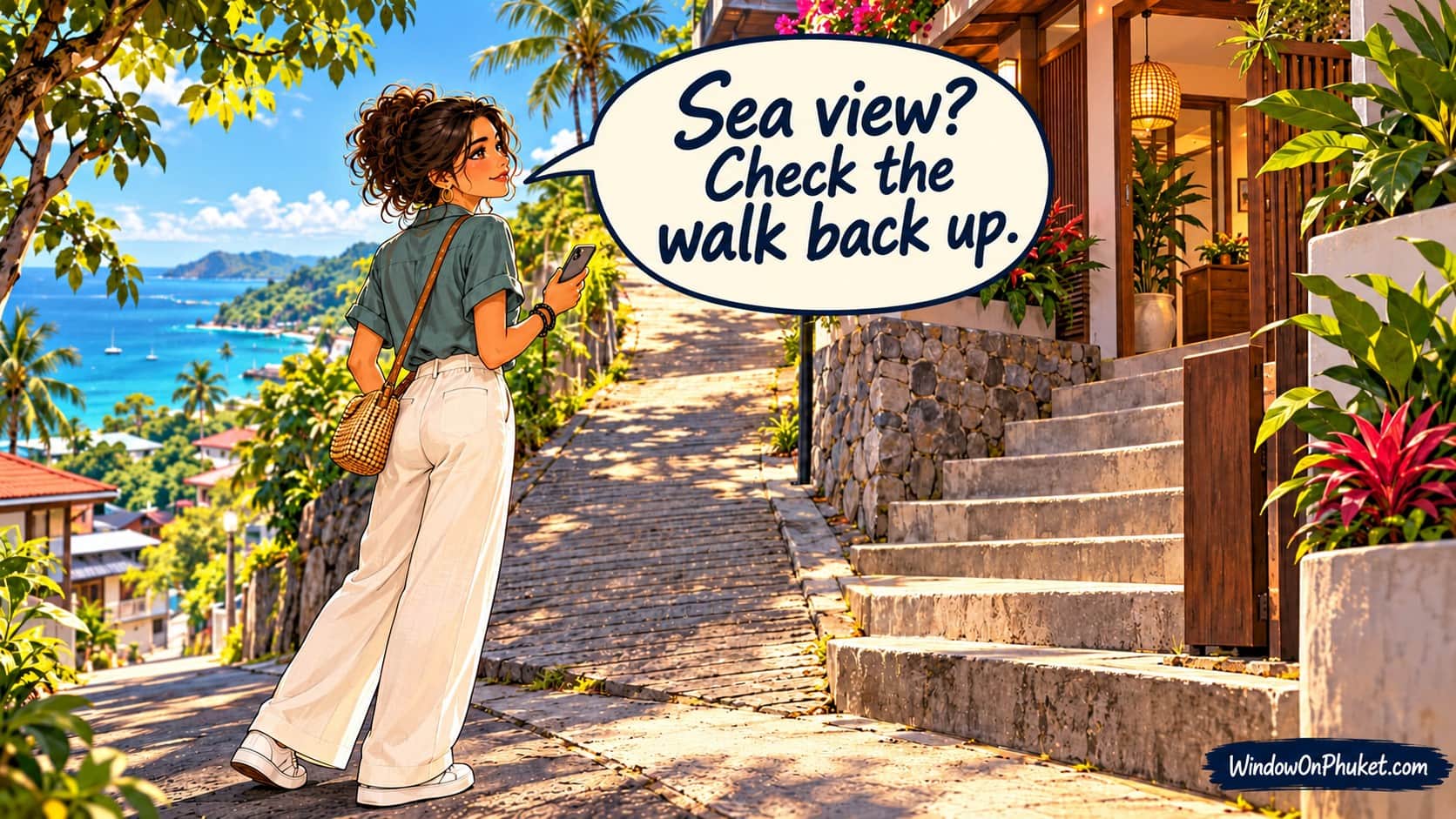
A hillside property can have open sea views and still require a vehicle for an evening meal. A hotel described as “near the beach” may involve a steep lane, a main road or a walk to a public entrance.
Ask the accommodation these questions before committing:
- Where is the guest entrance, and what is the actual walking route to the beach or restaurants?
- Does that route have steps, steep sections or stretches without a pavement?
- If a shuttle is advertised, when does it run, where does it stop and how is the return arranged?
- What remains reachable when it is raining or after dark?
- Is there current construction beside the building or along the access road?
Request the entrance map pin, not just the property’s central marker. For accommodation with several buildings, confirm the room location too. These checks are particularly useful around the more spread-out parts of Bang Tao and Laguna and hillside addresses near Kamala or Patong.
Plan the cost of a day, not just a room
Compare accommodation using the journeys it creates. A lower room price may save little if every meal and beach visit needs paid transport. For two possible hotels, price the same sample day: breakfast, a return beach journey, dinner and the ride home. Compare the total for the whole travelling party.
Before booking a driver, establish whether the quote covers a one-way journey, a return with a fixed collection time or several hours of waiting. Confirm the stops, passenger and luggage capacity, any child-seat requirements and possible extra charges. Save the agreed details.
Walking works for particular streets and neighbourhoods, rather than as a general transport plan for Phuket. Check the return route as carefully as the outward one. Do not make the holiday depend on learning to ride a scooter after arrival.
The Getting Around Phuket guide covers transport choices. For the arrival journey, compare a pre-booked airport transfer with the other options described in the Phuket Airport Guide.
Group outings so the day holds together
Choose one main outing and add nearby stops only if time and energy allow. Keep meals near the day’s route instead of creating another crossing of the island for lunch.
These are suggested groupings, not timed itineraries:
- A town day: keep Old Town streets, a café or museum stop and a meal in the same part of town. Check each venue’s opening day before setting off.
- A southern outing: combine time around Rawai with Nai Harn and Promthep Cape, allowing for the journeys between them. Treat the beach stop as time by the coast; swimming depends on conditions.
- A local beach day: stay around the beach nearest the accommodation and explore its adjoining streets. It does not need another beach added to justify the day.
- A boat-trip day: allow for hotel collection, the journey to the pier and the return transfer as well as time on the water. Leave the evening free of reservations that depend on an exact return.
Phang Nga Bay and Phi Phi are separate excursion choices. Before booking islands and day trips from Phuket, compare the departure pier, boat type, time aboard, collection area and cancellation terms, rather than only the headline destination.
Decide which plans need flexibility

If daily sea swimming or a particular boat trip is central to the holiday, review the Best Time to Visit Phuket guide before choosing dates. A room with a pool and comfortable covered space provides another option when the sea is unsuitable or rain interrupts the day.
Do not fill every day with non-refundable outdoor bookings. Keep an alternative that does not depend on the sea, such as a meal, a town visit or an indoor stop, and check local conditions before travelling. Rain can also affect roads and outdoor sightseeing.
Red flags mean do not enter the sea. Sunshine does not establish safe swimming conditions, and an unflagged or unstaffed beach is not a guarantee of safety. Follow lifeguard instructions. Use the Phuket Beach Guide to choose a location, then assess conditions there on the day. The Is Phuket Safe? guide covers wider precautions.
Prepare documents and the first night

Check entry conditions for the actual passport, purpose of travel, length of stay and route. Use the official Thai e-Visa website and the relevant Royal Thai Embassy or Consulate. Visa exemption and permission to stay should not be inferred from somebody else’s trip.
For non-Thai visitors passing through immigration into Thailand, complete the Thailand Digital Arrival Card (TDAC) before arrival, within the official three-day submission window, including the arrival date. Submission through the official site is free. The TDAC is an arrival form, not a visa. A domestic flight to Phuket after entering Thailand elsewhere is not a new entry into the country.
Save the accommodation’s address, entrance pin, telephone number and arrival instructions offline. Keep the TDAC confirmation and relevant travel documents accessible without mobile data. Arrange travel insurance that covers the planned activities, and check any conditions before hiring a vehicle or booking an activity.
Requirements for medicines, health documentation or items carried in luggage can depend on individual circumstances.
For a late arrival, confirm reception arrangements and a workable way to reach the property. Check how food will be obtained if arrival is after nearby kitchens close. Keep the first evening simple rather than paying for an excursion or fixed dinner reservation immediately after landing.
Have a workable first-day setup
Keep some Thai baht in small notes for purchases where a card is not accepted. Carry a backup payment method separately. Do not assume that a Thai QR-payment sign means a foreign banking app can pay it.
At a cash machine or exchange counter, read the displayed fee and conversion terms before accepting. Compare the amount received after charges rather than the advertised rate alone. Your daily spending depends on your plans. Eating locally and staying near your hotel will cost much less than taking private transfers and a boat trip.
Arrange mobile data or a roaming plan before relying on map navigation and ride bookings. Check that the phone supports the chosen SIM or eSIM and that the plan includes the calls or messages needed. Keep a charger and power bank in hand luggage, subject to the airline’s current battery rules.
For departure, work backwards from the airline’s required check-in time and add the journey from the actual accommodation. Ask about current road conditions and allow a separate buffer for delays. A map estimate is a planning aid, not a promised airport arrival time.
Make room for everyday Phuket

Allow time for a meal or a short walk near the accommodation instead of treating every free hour as a transfer between sights. Markets, local restaurants, working streets and religious places are part of a lived-in island.
At Buddhist temples, cover shoulders and knees, follow signs about footwear and photography, and keep clear of worshippers. Beachwear belongs at the beach or pool rather than inside temples or ordinary town businesses.
For eating out, the Is Street Food Safe in Phuket? guide explains stall selection and food precautions. A food allergy needs a separate conversation about ingredients and preparation; the appearance of a dish or a general request for “no seafood” does not establish that it is suitable.
A final check before pressing “book”
- Location: the entrance and daily walking routes have been checked.
- Cost: accommodation has been compared with the transport it creates.
- Dates: weather-sensitive plans have room to move.
- Bookings: room, arrival transport and any limited-availability activity are confirmed where needed; cancellation terms are understood.
- Arrival: documents, offline details, payment and the first night are covered.
- Departure: the return transfer and airline timings fit together.
The Essential Phuket Travel Guides bring the detailed topics together. Once the base, arrival and any fixed bookings are settled, leave space for days that stay close to where the holiday is actually being spent.
