
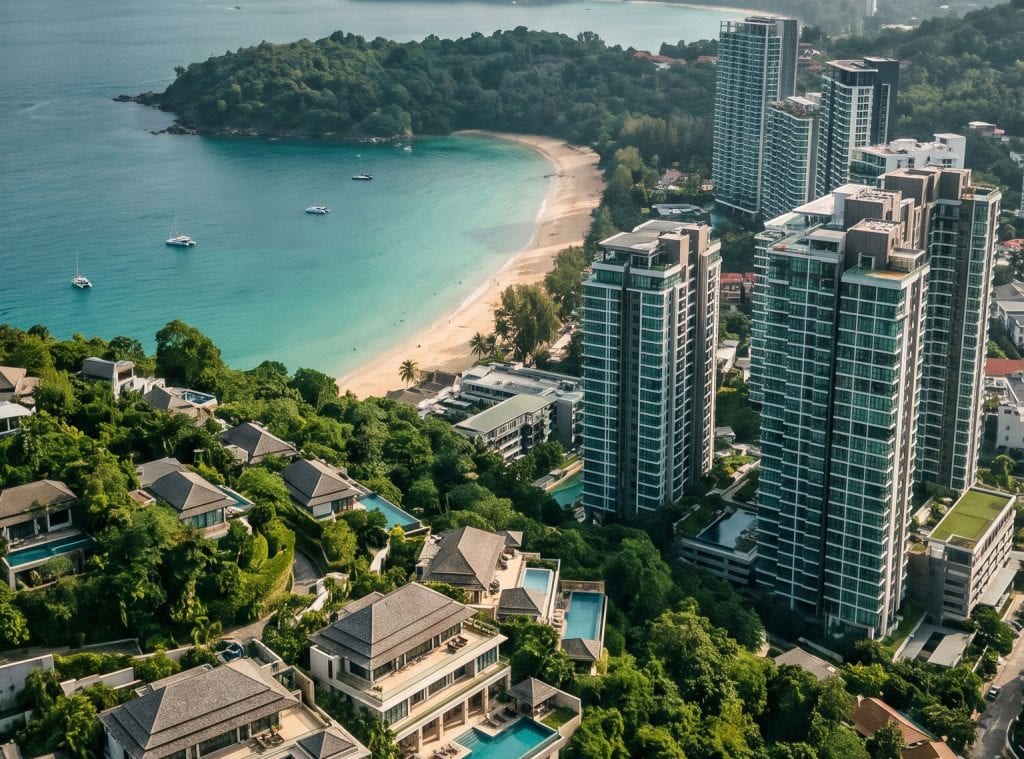
Phuket’s real-estate market has always been unlike most others worldwide. It is a relatively small
island with limited developable land, a highly international buyer base and a market that is not driven by
widespread mortgage finance in the same way as many Western property markets.
Location also has an unusually powerful influence on demand. Phuket’s west coast, with its crystal-clear
waters, exceptional beaches, established tourism infrastructure and concentration of luxury hotels, has
traditionally attracted far greater interest than many other parts of the island. Buyers are not simply
comparing properties by size and price. They are comparing beaches, views, lifestyles, legal ownership
structures and access to the areas they know from their holidays.
These characteristics have always produced considerable differences between individual locations and
property types. However, the Phuket market now appears to be dividing into even more distinct segments.
The Growing Divide Between Villas and Condominiums
The most significant change is the widening gap between the villa and condominium markets.
Thai authorities have intensified their campaign against companies using nominee shareholders to hold
land on behalf of foreign nationals. Illegal nominee arrangements have never been permitted, but the
increased investigations, publicity and enforcement have made it very clear that these structures will no
longer be overlooked.
The effects are being felt throughout the villa market. Lower-priced landed properties, medium-priced
pool villas, luxury residences and even super-luxury villas are all facing greater buyer caution.
This does not mean there is no longer a villa market in Phuket. Buyers still want space, privacy, gardens
and private swimming pools. However, prospective purchasers are asking more questions about
ownership, legal security and future resale. Some are delaying decisions, while others are reconsidering
landed property altogether.
Even buyers who would never knowingly use an unlawful nominee arrangement may become nervous
when the distinction between illegal structures and legitimate ownership options is not properly explained.
The resulting uncertainty is affecting sentiment across the entire villa sector, rather than only the
transactions that the authorities are targeting.
Condominiums Are Still Selling, But Demand is Fragmented
The condominium market is continuing to record sales, partly because qualifying foreign purchasers can
own a condominium unit directly in their own name within the building’s foreign ownership quota.
This clear legal ownership route has become increasingly attractive while questions surround certain
forms of villa ownership. However, the condominium market is also experiencing its own significant
divide.
Phuket has seen an unprecedented wave of new condominium developments launched across the island.
Although the market is still recording sales, buyers are now choosing between dozens of competing
projects.
Before the pandemic, a smaller number of launches could capture a much larger proportion of active
demand. Today, even when the total number of condominium sales appears respectable, those transactions
are divided among far more developments. Consequently, a reasonably active overall condominium
market does not necessarily mean that every individual project is selling rapidly.
The result is a market in which a few projects may perform strongly while many others sell at a much
slower pace.
Entry-Level Prices Rise While Resale Growth Remains Limited
Another contradiction is emerging within the lower-priced condominium market.
The cost per square metre of many new entry-level units has increased substantially compared with only a
few years ago. Rising land values, particularly in desirable west-coast locations, together with higher
construction and development costs, are making genuinely affordable condominiums increasingly difficult
to deliver.
Nevertheless, the resale values of many lower-priced units are not rising at the same rate.
The principal reason is choice. Buyers can compare an enormous number of new units, often offered with
modern facilities, furniture packages, payment plans and other developer incentives. An owner attempting
to resell a relatively ordinary unit must compete against this continuous supply of newly launched
properties.
This creates an unusual situation in which the initial cost of buying an entry-level condominium is
increasing, while the potential for strong short-term capital appreciation may remain restricted by the
sheer volume of competing stock.
Luxury Foreign-Freehold Condominiums Show Greater Resilience
At the opposite end of the market, well-located luxury foreign-freehold condominiums appear to be
holding up considerably better.
Phuket has far fewer genuinely luxurious foreign-freehold condominiums than standard entry-level
developments. Quality projects in strong locations, especially those with sea views, beach access,
generous living areas, high ceilings, professional management and established rental appeal, remain
comparatively scarce.
For buyers who do not require a private garden, or for whom condominium pet restrictions are not a
concern, the attraction is easy to understand. They can acquire a high-quality residence with registered
ownership in their own name, without the land-ownership questions currently affecting the villa market.
Discerning purchasers can also see the longer-term value of scarcity. If developers continue concentrating
on smaller, lower-priced units while failing to address the undersupplied luxury foreign-freehold segment,
the best existing developments may experience stronger demand and increasingly limited resale
availability.
Of course, simply attaching the word ‘luxury’ to a project does not guarantee future performance.
Construction quality, location, management, unit size, foreign-freehold availability and the long-term
desirability of the development remain essential.
Development Continues Despite Changing Sentiment
It may appear strange that construction continues at such a pace while demand is becoming more
selective. However, property development moves slowly. Many current projects were planned, financed or
purchased during the strong post-pandemic period, when confidence was higher and developers expected
rapid growth to continue.
There is now a risk that supply is arriving after the market has already changed.
At the same time, the tone surrounding foreign investment and tourism has become increasingly negative.
News of investigations, tougher enforcement and disputes involving foreigners is amplified through social
media, where individual incidents can quickly create the impression of a much broader hostility towards
international visitors and residents.
As these changes unfold, we hope Thailand continues to reassure legitimate investors, long-term residents
and ordinary tourists that they remain welcome and will not be viewed with suspicion simply because
they are foreign.
A More Selective High Season
The approaching high season will provide an important test. Phuket will undoubtedly continue attracting
visitors, but it may be unrealistic to assume that every high season will automatically outperform the last.
Economic uncertainty, higher travel costs, extensive new property supply and negative online sentiment
may all influence decisions. Some visitors may still come to Phuket for a holiday but become more
cautious about investing, purchasing a second home or relocating permanently.
The Phuket property market is therefore not simply rising or falling as one. It is dividing into villas and
condominiums, new developments and resales, entry-level and luxury properties, and legally
straightforward ownership structures versus those now facing much closer scrutiny.
Phuket has always been a collection of highly individual property markets. What we are seeing now is an
even greater segmentation, and the properties most likely to succeed will be those combining genuine
scarcity, realistic pricing, strong locations, quality construction and complete legal clarity.
